
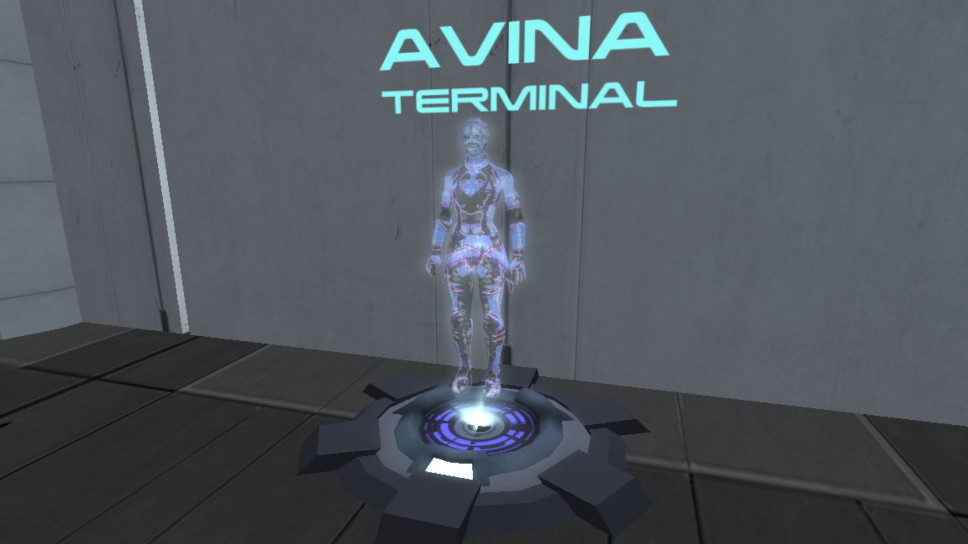
Well, just like a similar term that starts with "A", VI is yet another thing from science fiction and adjacent activities (i.e. futurism) that became popular... in, um... popular culture... or something like that. And yes, yes, the Dartmouth workshop, blah, blah, whatever, the term AI became popular because science fiction, not because academic workshop. True story.
Now, because science fiction and computer games and television and all that stuff, two arguably most popular embodiments of the term VI are Avina, a VI Terminal, from the Mass Effect computer game series, and The Doctor, an Emergency Medical Hologram, from Star Trek Voyager TV series.
None of these two are considered to be an "AI" constructs in their respective imaginary worlds, but instead they're something in between a "dumb" computer machine (in Star Trek universe, ship's main computer is literally called "The Computer") and a "conscious" AI machine. Avina is being referred to as "VI" in the game, whereas The Doctor was never explicitely referred to as VI but as "a hologram" or "an EMH", however it could also be classified as a VI because it is considered to be intelligent but not on par with an AI machine.
So. Virtual Intelligence. What gives?
Well, allow me, dear reader. Hear me out.
Once the dust around current AI frenzy settles (let's just leave it at that), we human beings who are lucky to have access to these kind of things, will be left with a handful of new information technologies we can choose to use in our projects and maybe everyday lives. Like, semantic search but better, pattern recognition but better, generative algorithms but cooler, etc. AI and AGI will not be a thing, but one of the things that will become prevalent and will be a distinct mark of differentiation between how majority of IT applications work now and how it will work in that (near?) future, is natural language processing in the context of human-machine interface. Oh, I mean, talking. To a computer. And it talks back.
What? We already have that? Lolsies. No, we don't. I'm not talking about those amusement park parlor tricks. Here's what I have in mind.
The IT systems you already have in your business: databases, web applications, processing pipelines, REST APIs, GraphQL endpoints, data lakes, etc, etc, contain encoded in them (with literal computer code) rules and processes and transformations and actions and all that good stuff that we call "business logic". The IT systems you already have in your business contain the essence of how, what and where your business handles, and how it processes all the data and information that are significant to it.
In other words, all that hardware (or cloud infra) and software you already have in your business contains encoded the intelligence of the business you do.
Not all of the intelligence needed to do the business, but quite a bit of it, and important parts of it too. For example, if you are doing retail and you have return policy, I'm pretty sure there's some code somewhere that has bunch of if-then-else stuff in it that handles all the parts of the product return process that can be automated, and your humans are then handling parts that are unforseen exceptions, or that can't be encoded in some way or another in that IT machine of yours.
And that is the "Intelligence" part of VI, you already have it in your current IT infrasturcture: from backends and pipelines, to apps, web applications and internal UI tools. The thing is, in order to interact with that intelligence, you have to learn to use computer interfaces built for humans (but of course): forms, buttons, drop-downs, spreadsheets, menus, terminal commands, and what have you else. And then, sometimes, you have to strain to understand what you got back and is it a proper output or maybe an error or something.
Right. Now, take this new thing, I'm going to call it "a model", that can process natural language (you know the one we humans use to communicate with other humans) and convert sentences of that language into whatever it is that your IT infrasturcture "understands": API calls, XML files, terminal commands, HTTP multi-part form requests, SQL statements, whatever, and you add that new thing, "a model", to your existing IT infrasturcture. Now, with that thing added (or "plugged in" maybe?), besides being able to click buttons and tap checkboxes, you can also use words, speak them, the "model" translates that into your IT infra "language", and once your IT infra returns result(s) of operation(s), the "model" translates that back into words you can understand.
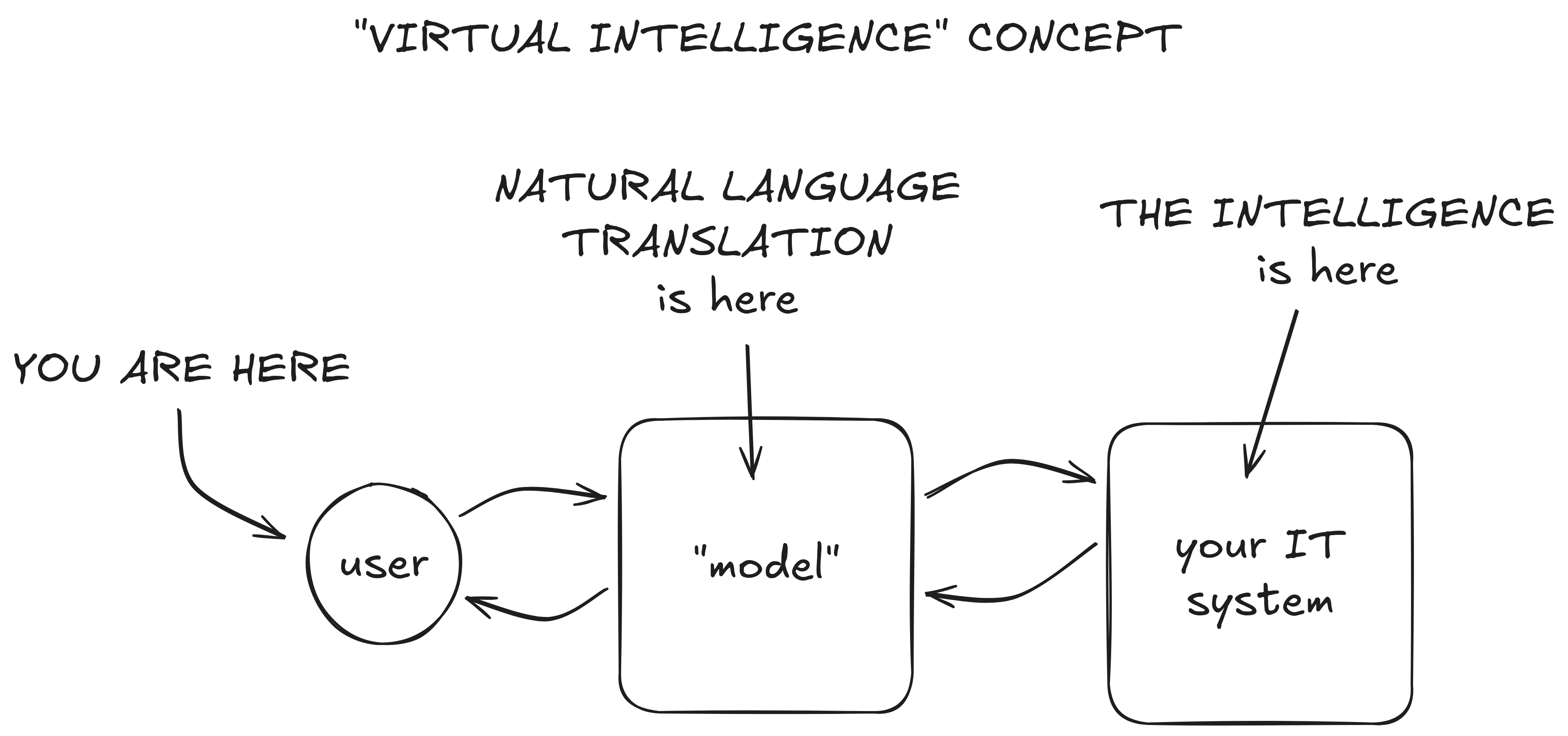
It would look as if your IT infrasturcture, the one you have right now and which I'm sure you spent bajillion moneys to build, suddenly gained ability to speak (which it, techically, did) and not only that, but it seems as if it can understand what you want it to do, it does what it can, and then talks back in no uncertain terms what the result of the work was, or lack thereof. It would look as if you are talking to an intelligent machine, albeit one with somewhat limited intelligence, compared to what you would expect from an average human being. It wouldn't be able to tell you a joke, for example, or write a haiku poem (why would you do that?) but it would definitely be able to find, run and then show you that quarterly report you need done yesterday.
This thing would not be that "artificial intelligence" an academic out there is expecting it to be, it would not be the AI your average cosumer is hoping to see jump out of movies, novels and anime series into real life. It would insetad be something that resembles an intelligent machine, it would be not a simulation but an emulation of intelligence, and is thus fittingly named "Virtual Intelligence".
Like, it's not R2D2, or C-3P0, or Commander Data, but it does do an actually useful work. Because your existing IT system is doing the work. And it better be useful, why the heck did you spend all those bajillion dobloons on it otherwise? And with added conversational interface, which the "model" is responsible for, it turns into this interactive VI... terminal? Hologram? Talking glowing orb? I don't know, something or other like that...
Anyways, if you are thinking "agents" or something along those lines right now, I have to disappoint you: no, that's not what this "model" is.
You see, LLMs are being sold as the source of intelligence, thinking machines, mechanisms that can figure out on their own how to solve whatever problem you may have in your line of work. Then, an "agent" is that kind of a thinking, intelligent LLM-based machine that has been given access to our everydey environment, to "the world" if you will, via a set of "tools". And now that LLM, that thinking, smart cookie is using those tools: REST calls to weather APIs, requests for your calendar content, image recognition tool that generates verbal description of an image, compiler that compiles source code, etc, etc, it uses the tools to help itself interact with environment and to, like, think about it, and to, you know, like, do useful work. That's what is known these days as an "agent". And that set of tools with an LLM plugged into it, we call it "harness". Or was it just the tools without the LLM we call that? I don't know. Whatever.
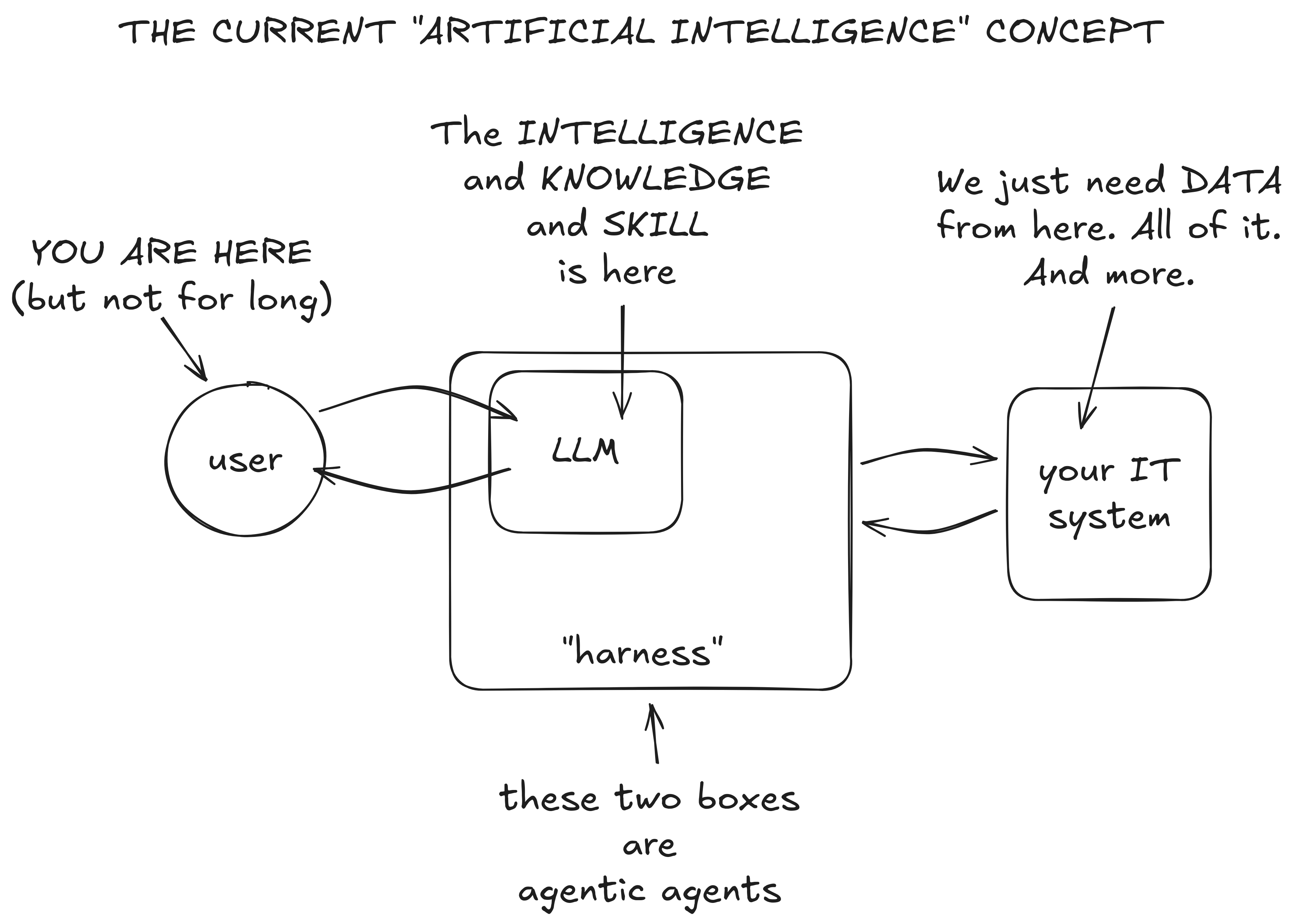
An LLM being sold as a thinking machine, and then having a bunch of tools attached to it to make it look like it's now doing meaningful work in the "real" world, that's an amusement park parlor trick. Because LLM, or any version of it, is not a thinking machine.
The "model" I'm talking about, the thing that is part of the Virtual Intelligence machine, that model is something almost, but not quite entirely unlike LLM.
Yes, it has semantic embeddings, it also makes sure that context is taken into consideration during processing, and yes, it then generates output. But it's not the "most likely" output. It's the closest, predefined output. Or the highest scored one from a handful of closest, where it also gives those options to you. Or it errors out if it can't find the proper output. And it generates a graph construct through layers which you can track and visualise (for programming, aka "training", and for debugging and diagnostics), and then produces an output from that for your IT machines to consume. And then it translates whatever the machines produce back into natural language. And it has exact, correct references. And if what it gives back looks and sounds strange, you can trace that particular interaction via those graphs I mentioned and figure out exactly what went astray. Very little, to none, guessing required.
That "model" is a better child of LLM. It's not unlike a translation machine, but one on steroids. But not steroids athletes use, like when you go to gym and you want to become like a giant muscle monster, groowwl, rooaar, and stuff, noooo. That's not what I'm talking about. I mean the kind of steroids they give to cattle, you know, to get those reeeeealy big cows and stuff, have you seen those? They get like as tall as two human standing on top of each other. Not like one human is lying down and the other stands on it, but like one human stands and the other one climbs to stand on top of their head. A cow that high. Yup.
What was I talking about?
Ah, yes.
Virtual Intelligence.
The "model" you would need for this Virtual Intelligence is made out of bits and pieces LLMs are, but there are few nicknacks that need to be interspersed inbetween those to get to this "model". I'm using quotes because I need a better name, but I got all the way here into the article and still haven't come up with one, so I'll just keep using quotes. And once you have this natural-language-to-machine-interface-and-back "model", you'll very likely need to tweak your IT infrastructure a bit here and there to make it easier to integrate the two. Not unlike people want to add MCP everywhere nowadays. But for VI you don't need to do something that drastic, you would probably just need to add a facade to some obscure endpoints, to maybe clean up that API you already have, or to finally document a proper API that is just missing the documentation, and so on. And then you plug one thing, the "model", into the other, the IT infrastructure. And you get the VI for your business. A proper, useful tool.
And so, all of it together becomes a new thing you can interact with, the same way artists have envisioned in tose sci-fi shows, books, games. You talk to it like you'd talk to Avina or The Doctor. And they give you correct, proper answers (whatever comes out of your IT system as the result) or they tell you there's no answer or there was an issue, an error, an exception during processing. You know, as if when you are doing a proper work in order to do you job or whatever. And you don't need to replace your entire IT infrastructure with this new "thinking" machine, or to spend bajilion of dobloons on "tokens" or "chips" or whatever other fake commodity. You take this new "model" technology, (it's not an LLM, but it's similar, but not really), tweak it so it "learns" to talk to your particular IT infrastructure, then you run it on another cloud compute instance you add to your existing VPC or whatever, and that's it. No need for another data center, just another compute instance, or two, to run your "model". Your new UI, a new human-machine interface.
We (engineers) still need to do some work to make that "model" that is part of the Virtual Intelligence machine a usable thing, like for example, Apache Web Server is, or Spring Framework, or Angular framework, or what have you. You know, like: download this, install that, configure it using these tools, connect to it like this, here's how you debug it, here's how you customize it, off you go now.
In the meantime, if you just want to play around, or maybe you secretly want to be the author of the next "Attentions is what you crave" paper, or if you are simply one of those poor souls who have got a directive from above to spend money on "integrating AI" into your business, you can leverage existing tools and toys from the current "AI" world, and maybe get something close to a proper VI system. That may get you to some point where you have an actual useful upgrade to your existing IT infrastructure, and hopefully carry you over to the time where VI systems will be a common thing to include into your infrasturcture like, I don't know, the nginx proxy is.
To start with, LLMs can translate from natural language into MCP or really whatever else your IT services consume, you may need to do a bit of additional work there, look at the existing agent harnesses and use whatever bits, bobs and pieces look useful to build the LLM-to-your-system interface, you'll also probably need to add additional validations to those requests, and responses, and then "teach" in some way the LLM you chose for this role to, hopefully, correctly interpret the validation errors, or your API errors, and of course the valid responses. You may need to add a bit more scaffolding to translate all the different responses your IT infrastructure offers into something that is still structured (and thus can be validated with rules) but easier for an LLM to translate into meaningful natural language response.
The main guideline in all of this is: LLM is not a thinkgin machine, your existing IT system is. LLM is there to translate stuff from human speak to machine speak and back.
Do that and you have already placed one foot onto a proper path to that bright, shiny, futuristic... er... future... thinge... thingamajig.
Also, you'll have a way better chances of seeing an actual, proper, useful improvement to your business workflow, instead of spending your time and dobloons paying the magician for magic cards. Just my opinion, man.
Peace.